FOOTLY RESEARCH / PUBLISHED POLICY AUDIT
Getting Paid for Feet Content: A Four-Platform Payout Rules Audit
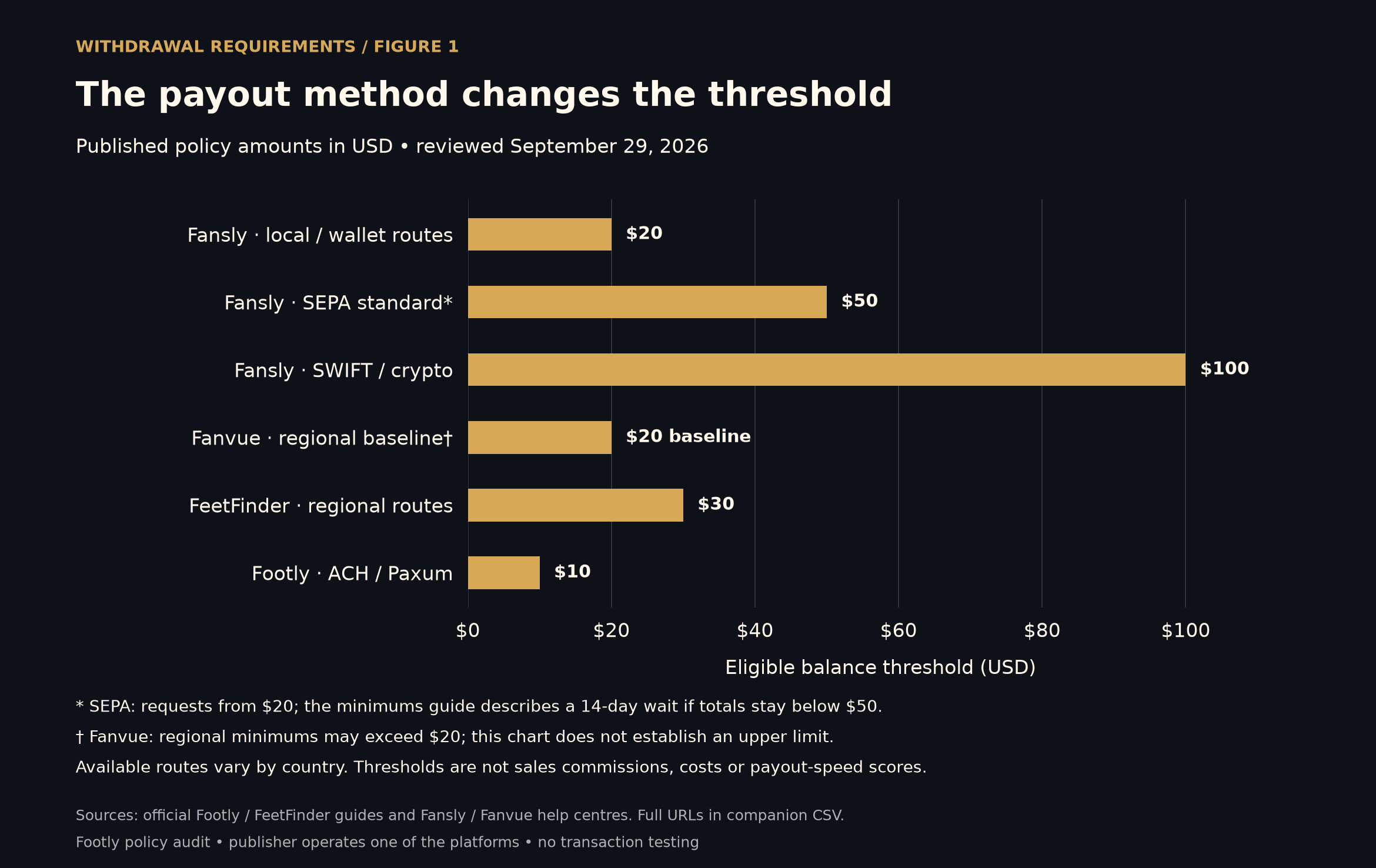
Published withdrawal thresholds range from $10 to $100 across the methods we reviewed. The minimum is only one part of the journey from a sale to spendable money.
Research checked September 29, 2026 · Version 1.1 · Published by Footly

Selling a photo and receiving the proceeds are different events. Between them sit balance holds, withdrawal thresholds, account checks, processing schedules and sometimes a second transfer out of a payment wallet.
We reviewed 12 official guides, help articles and seller agreements covering Footly, FeetFinder, Fansly and Fanvue. The question was deliberately narrow: what do these platforms publicly say a creator must do before withdrawing earnings?
This is a comparison of published rules, not a test of actual payout performance. Footly operates one of the platforms included. Its policies receive the same qualifications as competitors’ policies below.
The published thresholds
Amounts are in US dollars. A threshold applies to eligible earnings, not necessarily the total sales figure shown in an account. The routes listed are not an exhaustive country-by-country availability list.
| Platform | Published withdrawal threshold | Methods or conditions described by the source |
|---|---|---|
| Footly | $10 | US bank ACH; international Paxum. Creator payout guide. |
| FeetFinder | $30 | Typically Segpay bank transfer in the US and Paxum internationally; actual options depend on location. Official seller guide. |
| Fansly | $20, $50 or $100, depending on method | $20 for Paxum, Cosmopayment and listed local bank routes; $50 standard SEPA threshold; $100 for SWIFT and cryptocurrency. SEPA has an exception below. Method-specific minimums. |
| Fanvue | $20 baseline; regional minimums can be higher | The platform explicitly qualifies its headline minimum by region. Withdrawal requirements. |
The $10–$100 range describes the documented thresholds in this sample. It does not mean every creator can choose either endpoint, or that a lower minimum produces a faster payout.
There are three separate clocks
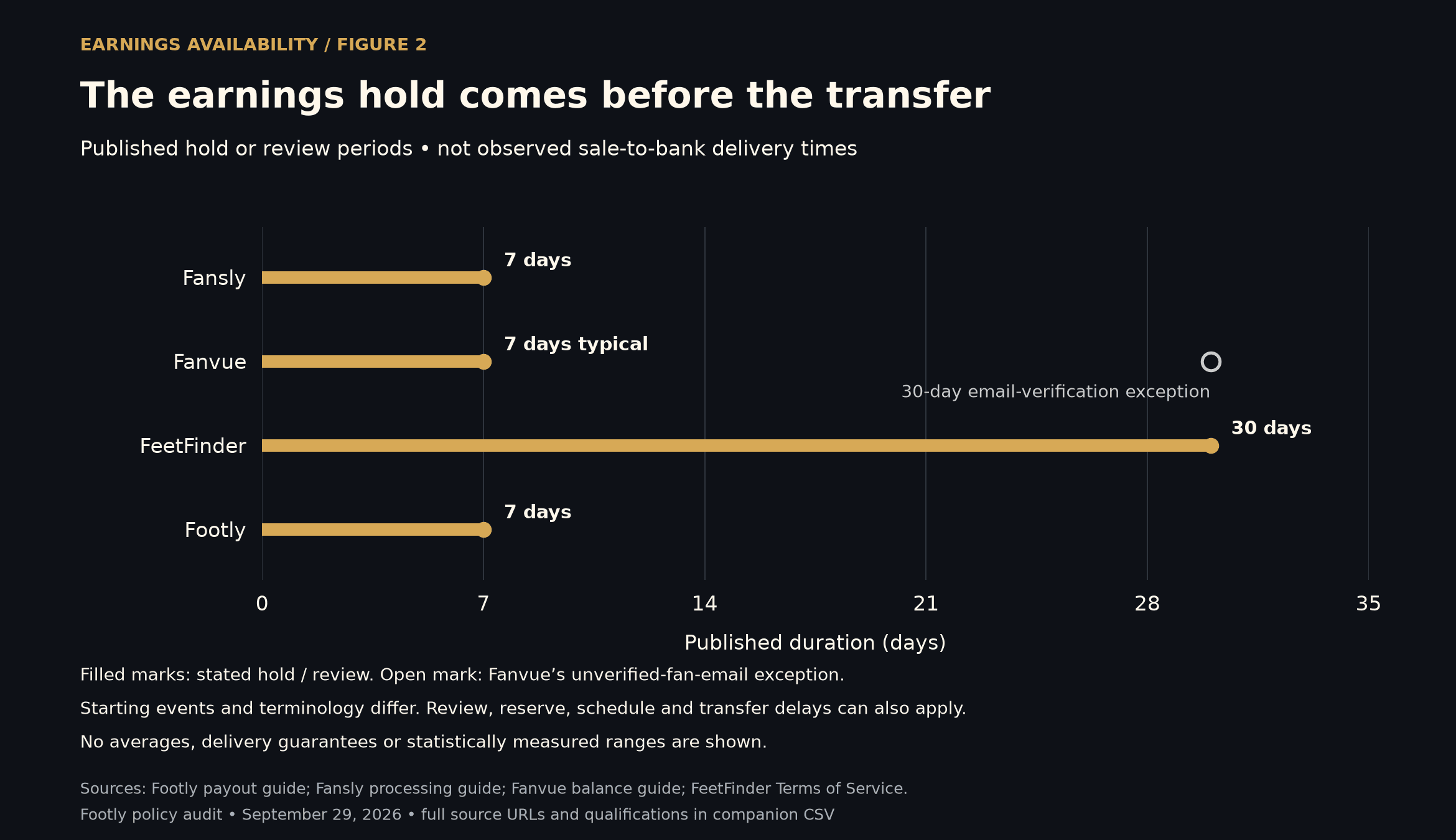
For comparison purposes, we separate the payout journey into three stages: earnings becoming eligible, the platform approving or scheduling a withdrawal, and the transfer reaching its destination. A quoted processing time may describe only the last stage.
Footly describes a seven-day processing period for new earnings, a weekly payout schedule and a security review of withdrawal requests. Its guide gives a typical ACH arrival window of one to three business days after initiation. Those business days should not be read as the entire time from sale to receipt. Footly payout timing.
Fansly describes a seven-day pending period, most request reviews within 48 hours, and typical delivery within one to three business days after the payout enters processing. International bank transfers and cryptocurrency also have batching rules. These are published expectations, not delivery times measured by this report. Fansly’s processing stages.
Fanvue describes a typical seven-day pending period, with a possible 30-day hold when a fan has not verified their email. Its withdrawal guide separately gives three to five business days to send a requested payout to the selected method. Balance availability, withdrawal timing.
FeetFinder’s Terms of Service specify a 30-day earnings review before payout. Its seller guide separately describes roughly three to five business days of processing plus bank transfer time. The review period and transfer window describe different stages. FeetFinder terms, Seller Payouts, payout guidance.
| Platform | Published hold or review | Qualification |
|---|---|---|
| Fansly | 7 days | Before funds become available; request review and transfer follow. |
| Fanvue | Typically 7 days | May be held for 30 days if the fan’s email is unverified. |
| FeetFinder | 30 days | Earnings review before payout under its Terms of Service. |
| Footly | 7 days | Completed, unreversed earnings; withdrawal review follows. |
Sources for Figure 2 and its accessible table are linked in the four platform paragraphs immediately above. Each source describes its own starting event; these values should not be added to business-day transfer estimates to manufacture an exact delivery date.
The exception a simple comparison table misses
Fansly’s standard SEPA threshold is $50, but its minimums article says creators can request as little as $20. If accumulated requests do not reach $50, the article says payment is sent 14 days after the initial request. A table reporting only “$50 minimum” would conceal this lower-value route and its waiting period. Fansly’s SEPA exception.
For anyone reusing these figures, the exception belongs beside the number. Removing it changes what the comparison means.
A sufficient balance may not be sufficient preparation
Fanvue’s withdrawal checklist also requires at least five uploaded pieces of content and verification of any featured co-creators. Adding a payout method can trigger a security review lasting up to 24 hours. This is an example of why account readiness belongs alongside minimum-balance comparisons. Fanvue’s payout checklist.
Geography introduces another variable. Fansly’s payer guide says that available options and currencies depend on the selected country and payer. It also notes that a receiving bank may charge for an international transfer. “Bank transfer available” therefore does not establish identical access or costs in every country. Fansly’s payer guide.
A platform payout fee is not the entire cost
Three different costs can sit between a customer’s payment and money a creator can spend: the platform’s sales commission, a withdrawal charge and any later provider or currency-conversion charges. This report compares withdrawal rules; it does not rank total selling costs.
Fanvue lists a 1% platform payout fee for TripleA and identifies it as the only provider currently carrying a Fanvue payout fee. Its separate MassPay guide describes fees for withdrawing from that wallet, varying by method and location. A platform-to-wallet transfer and a wallet-to-bank transfer are distinct steps. Fanvue payout fees, MassPay withdrawal guidance.
FeetFinder’s seller agreement likewise states that banks or e-wallet providers can impose transfer or currency charges. FeetFinder seller agreement, payout section.
Footly’s guide says it absorbs ACH and Paxum payout-processing costs. Its seller agreement nevertheless permits fees and reserves and identifies circumstances where earnings can be held or adjusted. The guide’s statement should not be expanded into a promise that every subsequent withdrawal, conversion or exceptional case is free. Footly payout guide, Footly seller agreement.
What this evidence establishes
The documents show why a useful payout comparison needs a method, a threshold, the conditions attached to it and a clearly defined starting point for any timing estimate. They do not establish which platform pays fastest in practice, which is most reliable or where a creator will earn the most.
Before relying on a payout route, confirm the available method in your own account, check which balance is eligible, complete the required verification and identify whether the destination is your bank or another wallet.
Methodology and reuse
This version is a manual review of 12 public, first-party documents accessed on September 29, 2026. We selected two feet-focused platforms and two broader creator platforms with public payout documentation. This is a purposive four-platform sample, not a representative industry census.
We recorded withdrawal thresholds, timing stages, route qualifications and selected fee disclosures. We did not create seller accounts, initiate transfers, survey creators or inspect private payout records. A missing value means it was not established from the reviewed documents. Policies and account-specific options can change.
The source-linked data file contains the extracted fields, exceptions and review date. Each substantive platform claim above links to its supporting document. Reuse should retain method and regional qualifications, identify this as a Footly-published policy review and distinguish published expectations from observed results.
Suggested citation: Footly, “Getting Paid for Feet Content: A Four-Platform Payout Rules Audit,” version 1.1, research checked September 29, 2026.
Version note: Version 1.1 adds two reproducible charts and FeetFinder’s Terms of Service as the twelfth source, resolving the unconfirmed review-period field in the initial draft. Source disagreements outside this report’s scope, such as commission percentages, are not converted into a platform ranking. For corrections, contact Footly with the relevant source URL and policy date.